
All products are for laboratory research purposes only. Not for human consumption.
Research blend: BPC-157, GHK-Cu, TB-500 and KPV co-lyophilised in one vial
KLOW
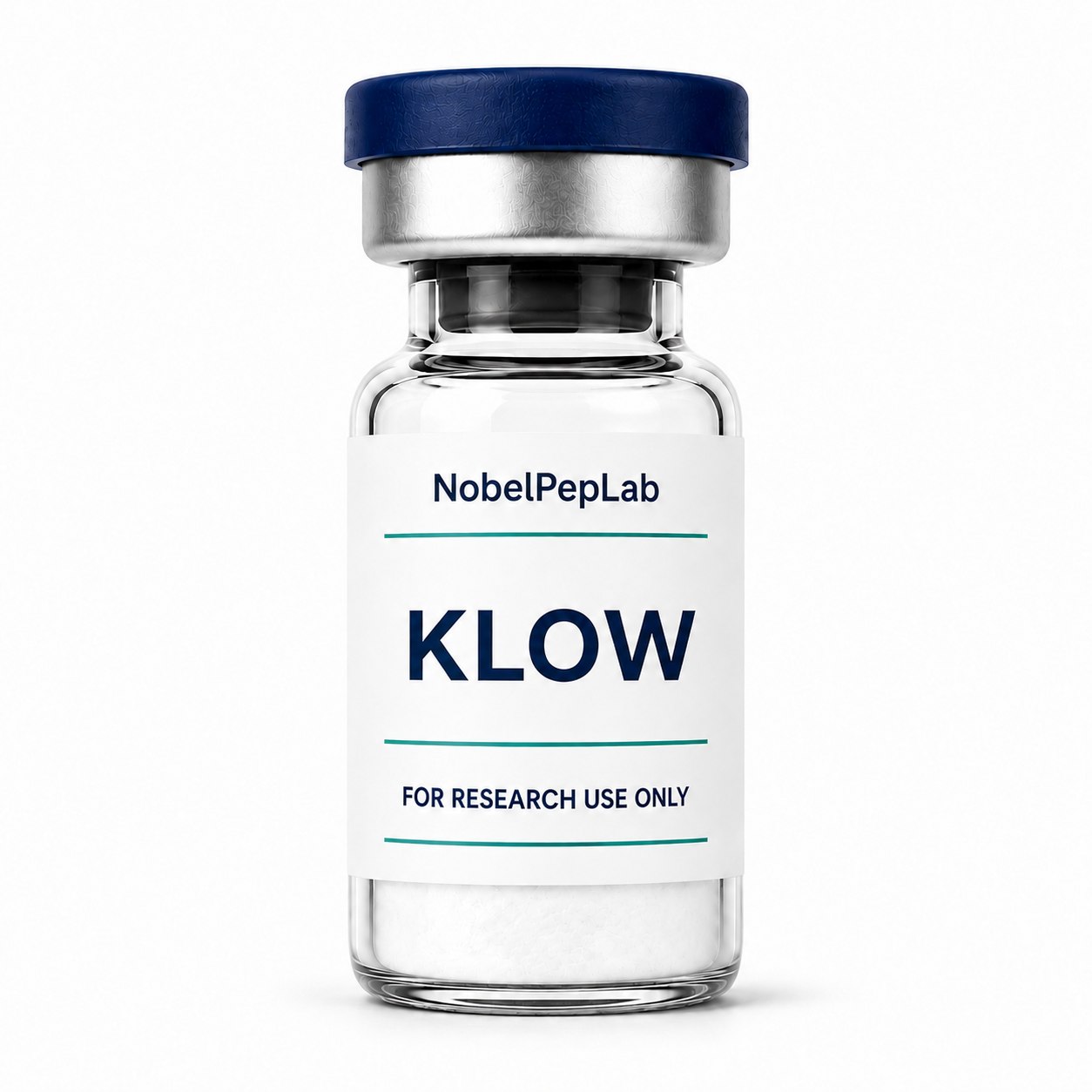
KLOW is a four-peptide research preparation: the GLOW combination of BPC-157, GHK-Cu and TB-500 with KPV added. The name is an informal market term - the K is the KPV addition. It is not a registered product or an approved formulation. Supplied as a lyophilised powder in sealed vials, boxed in tens, for laboratory research use only. We list what each component is studied for and say plainly where the evidence stops. A supplier claiming these blends work synergistically is describing an expectation, not a finding.
$190.00 (£150.10) per box of 10 vials · BPC-157 10 mg + GHK-Cu 50 mg + TB-500 10 mg + KPV 10 mg
Overview
What is KLOW?
KLOW is a four-peptide research preparation: the GLOW combination of BPC-157, GHK-Cu and TB-500 with KPV added. The name is an informal market term - the K is the KPV addition. It is not a registered product or an approved formulation. Supplied as a lyophilised powder in sealed vials, boxed in tens, for laboratory research use only. We list what each component is studied for and say plainly where the evidence stops. A supplier claiming these blends work synergistically is describing an expectation, not a finding.
KLOW at a glance
| Compound | KLOW |
|---|---|
| Also known as | KLOW blend, KLOW peptide blend, GLOW plus KPV, KLOW stack |
| Classification | Research blend: BPC-157, GHK-Cu, TB-500 and KPV co-lyophilised in one vial |
| Purity | 99%+ by HPLC |
| Physical form | Lyophilised powder |
| Available strengths | BPC-157 10 mg + GHK-Cu 50 mg + TB-500 10 mg + KPV 10 mg |
| Box quantity | 10 vials |
| Price from | $19.00 per vial ($190.00 per box) |
| Research status | GHK-Cu carries human skin data; KPV, BPC-157 and TB-500 are preclinical, with KPV the best characterised of those three through rodent colitis models. The four together have not been studied - no published trial has tested this combination, or any subset of it. Not approved as a formulation anywhere, and BPC-157 and TB-500 are prohibited in competitive sport under WADA S0. |
| Documentation | Batch-specific COA (Janoshik or Freedom Diagnostic) |
Nominal specifications. The authoritative figures for any given box are those printed on its batch COA.
Pricing
How much does KLOW cost?
KLOW starts at $19.00 per vial (£15.01), sold in boxes of 10 at $190.00. One box is the smallest order and there is no trade account or minimum spend. Larger volumes are negotiable.
| Strength | Per vial | Box of 10 |
|---|---|---|
| BPC-157 10 mg + GHK-Cu 50 mg + TB-500 10 mg + KPV 10 mg | $19.00 £15.01 | $190.00 £150.10 |
Handling
How should KLOW be stored and reconstituted?
Full explanation of why each of these matters: peptide handling and storage reference.
Research Context
What is KLOW researched for?
Below is a plain-English summary of what published research has investigated, and what it has found. These are descriptions of research activity and published results. They are not claims about what KLOW does, and nothing here is a statement that it is safe or effective for any purpose.
What KPV adds
KPV is the three-residue tail of alpha-MSH, studied for anti-inflammatory activity. In cultured cells it reduces NF-kB signalling, and in rodent colitis models it lowers tissue damage scores. Controlling inflammation is the one property the other three components are not primarily studied for, which is the stated reason for including it. 1
The three GLOW components
GHK-Cu is a copper tripeptide reported to increase collagen and matrix protein production in skin fibroblast culture, with decades of cosmetic use behind it. BPC-157 and TB-500 are studied in rodent tendon, ligament and wound models, for new blood vessel formation and cell migration respectively. 234
GLOW and KLOW as a comparison pair
KLOW contains the same amounts of BPC-157, GHK-Cu and TB-500 as GLOW, with KPV as the only addition. The two preparations therefore differ by exactly one variable, which makes them a usable pair for isolating what KPV contributes in a given model.
What is not established
A four-peptide mixture multiplies the untested interactions. No study has tested any subset of this combination together, let alone all four, and no stability data has been published for a copper complex co-lyophilised alongside three other peptides.
References
- 1PepT1-mediated tripeptide KPV uptake reduces intestinal inflammation. Gastroenterology (2008). PMID 18061177
- 2Regenerative and Protective Actions of the GHK-Cu Peptide in the Light of the New Gene Data. Int J Mol Sci (2018). PMC6073405
- 3Stable Gastric Pentadecapeptide BPC 157 as a Therapy for the Disable Myotendinous Junctions in Rats. Biomedicines (2021). PMID 34829776
- 4Thymosin beta4: actin-sequestering protein moonlights to repair injured tissues. Trends Mol Med (2005). PMID 16099219
Links open the record on PubMed or PubMed Central. These are citations to published research, not claims about this product.
Compare KLOW
Applications
Where KLOW is used in the laboratory
- Combination protocols applying four peptides to one model, the widest premixed preparation in this catalogue
- Inflammation research, where KPV contributes the anti-inflammatory arm that the three GLOW components do not directly cover
- Extracellular matrix, collagen and connective-tissue repair models, drawing on the separate literature for each component
- Comparative work against GLOW, where the only variable between the two preparations is the presence of KPV
Verification
Does KLOW come with a COA?
Yes — every box. Each batch of KLOW is analysed by Janoshik Analytical or Freedom Diagnostic. The certificate confirms identity by mass spectrometry and purity by HPLC, and is tied to the batch number printed on the vial label. You can ask to see it before you order.

Example COA. You receive the certificate matching your own batch.
Questions
KLOW questions, answered
How does KLOW differ from GLOW?
KLOW is GLOW with KPV added. Both contain BPC-157 10 mg, GHK-Cu 50 mg and TB-500 10 mg per vial; KLOW adds KPV 10 mg. KPV is a tripeptide fragment of alpha-MSH studied for anti-inflammatory activity, which is the property the other three components are not primarily studied for. That single difference is what makes the two preparations useful as a comparison pair.
How much does KLOW cost?
KLOW starts at $19.00 per vial, sold in boxes of 10 vials at $190.00 per box (about £150.10). 1 strength available: BPC-157 10 mg + GHK-Cu 50 mg + TB-500 10 mg + KPV 10 mg. There is no minimum order.
What purity is your KLOW?
All batches test at 99%+ purity. Every box ships with a batch-specific Certificate of Analysis from Janoshik Analytical or Freedom Diagnostic, confirming identity by mass spectrometry and purity by HPLC.
Is there a minimum order for KLOW?
No. You can order a single box of 10 vials. There is no trade account, bulk commitment or minimum spend.
How is KLOW shipped?
Tracked and in discreet, plain packaging, dispatched within 1–3 working days. Delivery estimates are UK 5–7 working days, EU 8–10, USA 5–8 and rest of world 10–12. Full detail is on the shipping page.


