All products are for laboratory research purposes only. Not for human consumption.
C-terminal tripeptide of alpha-MSH (3 residues)
KPV
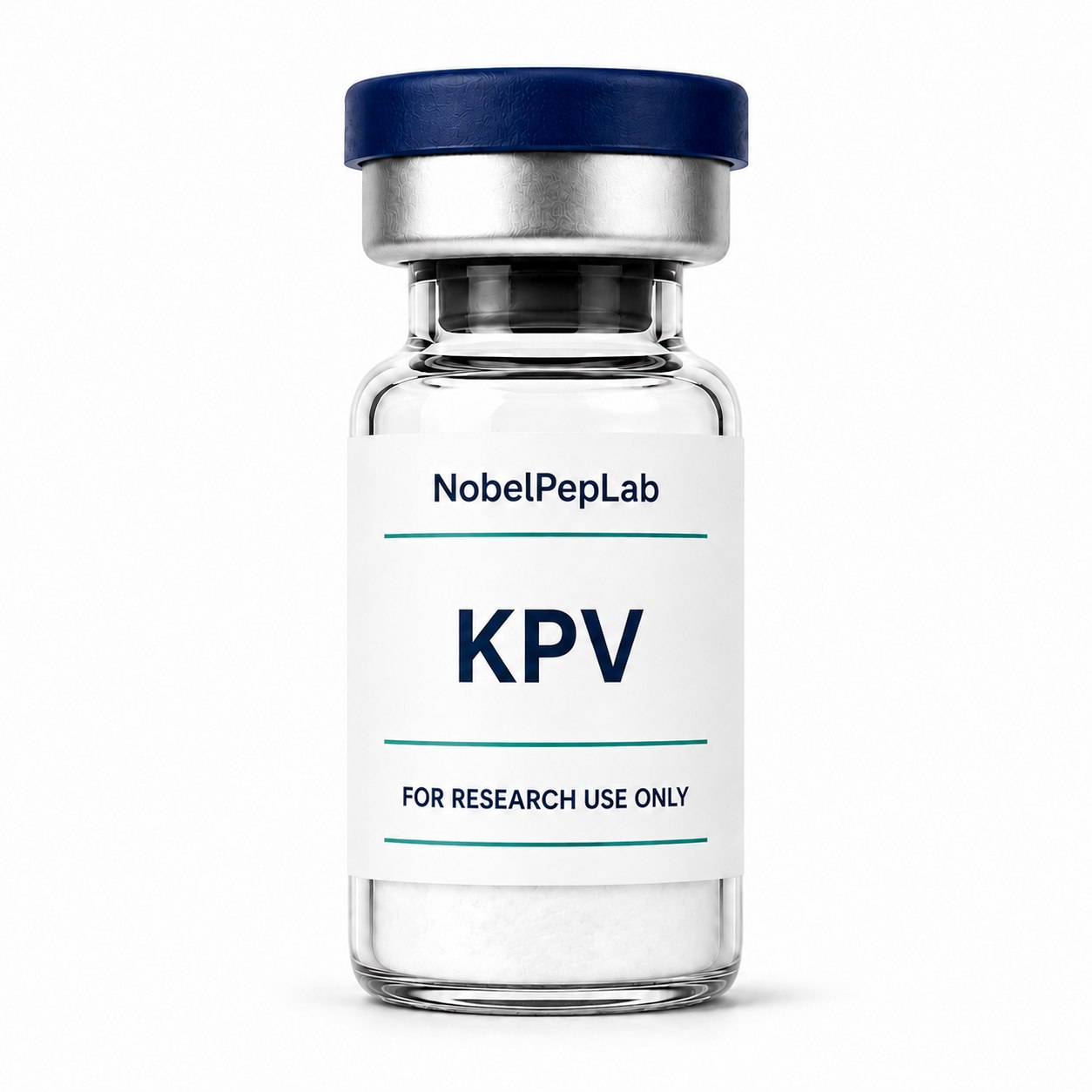
KPV is a tripeptide of lysine, proline and valine - the last three residues of alpha-melanocyte-stimulating hormone (alpha-MSH). Published work reports that this short fragment retains much of the parent hormone's anti-inflammatory activity in cell and animal models without the melanocortin receptor binding that drives pigmentation. Supplied as a lyophilised powder in sealed vials, boxed in tens, for laboratory research use only.
$85.85 (£67.82) per box of 10 vials · 10 mg
Overview
What is KPV?
KPV is a tripeptide of lysine, proline and valine - the last three residues of alpha-melanocyte-stimulating hormone (alpha-MSH). Published work reports that this short fragment retains much of the parent hormone's anti-inflammatory activity in cell and animal models without the melanocortin receptor binding that drives pigmentation. Supplied as a lyophilised powder in sealed vials, boxed in tens, for laboratory research use only.
KPV at a glance
| Compound | KPV |
|---|---|
| Also known as | Lysine-Proline-Valine, alpha-MSH (11-13), KPV tripeptide, H-Lys-Pro-Val-OH |
| Classification | C-terminal tripeptide of alpha-MSH (3 residues) |
| CAS number | 67727-97-3 |
| Molecular formula | C16H30N4O4 |
| Molecular weight | 342.44 g/mol |
| Sequence | Lys-Pro-Val |
| Purity | 99%+ by HPLC |
| Physical form | Lyophilised powder |
| Available strengths | 10 mg |
| Box quantity | 10 vials |
| Price from | $8.59 per vial ($85.85 per box) |
| Research status | Preclinical. Studied in cell culture and in rodent models, most often chemically induced colitis. No approved human use and no completed large clinical trials. |
| Documentation | Batch-specific COA (Janoshik or Freedom Diagnostic) |
Nominal specifications. The authoritative figures for any given box are those printed on its batch COA.
Pricing
How much does KPV cost?
KPV starts at $8.59 per vial (£6.79), sold in boxes of 10 at $85.85. One box is the smallest order and there is no trade account or minimum spend. Larger volumes are negotiable.
| Strength | Per vial | Box of 10 |
|---|---|---|
| 10 mg | $8.59 £6.79 | $85.85 £67.82 |
Handling
How should KPV be stored and reconstituted?
Full explanation of why each of these matters: peptide handling and storage reference.
Research Context
What is KPV researched for?
Below is a plain-English summary of what published research has investigated, and what it has found. These are descriptions of research activity and published results. They are not claims about what KPV does, and nothing here is a statement that it is safe or effective for any purpose.
Switching off inflammatory signalling
KPV is reported to enter cells and reduce the activity of NF-kB, the switch that turns on inflammatory genes. In cultured immune and gut lining cells this lowers the output of signalling molecules such as IL-6 and IL-8. Almost all of the KPV literature is built around this mechanism. 1
Gut inflammation models
The most-cited KPV work uses mice with chemically induced colitis. Reported findings include less weight loss, lower tissue damage scores and reduced inflammatory markers in the colon. These are rodent results; no equivalent human trial has been completed. 1
How a three-residue peptide gets into cells
KPV appears to be carried intact into intestinal and immune cells by PepT1, a transporter that normally handles small peptides left over from digested food. That delivery route is unusual and is part of why researchers study the short fragment rather than the whole hormone. 1
Antimicrobial activity in culture
Separate studies report that KPV inhibits the growth of Candida albicans and Staphylococcus aureus in culture. This is an in vitro finding at defined concentrations and has not been developed into any approved treatment.
References
- 1PepT1-mediated tripeptide KPV uptake reduces intestinal inflammation. Gastroenterology (2008). PMID 18061177
Links open the record on PubMed or PubMed Central. These are citations to published research, not claims about this product.
Applications
Where KPV is used in the laboratory
- Innate immune signalling research, particularly NF-kB pathway activity in cultured immune and epithelial cells
- Gastrointestinal inflammation models, including chemically induced colitis in rodents
- PepT1 peptide transporter studies, since KPV is reported to be taken up intact by intestinal and immune cells
- Comparative work alongside full-length alpha-MSH and other melanocortin fragments
- Antimicrobial screening against Candida albicans and Staphylococcus aureus in culture
Verification
Does KPV come with a COA?
Yes — every box. Each batch of KPV is analysed by Janoshik Analytical or Freedom Diagnostic. The certificate confirms identity by mass spectrometry and purity by HPLC, and is tied to the batch number printed on the vial label. You can ask to see it before you order.

Example COA. You receive the certificate matching your own batch.
Questions
KPV questions, answered
How is KPV different from alpha-MSH?
KPV is the final three amino acids of alpha-MSH, a 13-residue hormone. Studies report that this fragment keeps the anti-inflammatory activity of the whole hormone in cell and animal models while lacking the receptor binding that produces skin pigmentation. Separating those two effects is the main reason KPV is studied on its own rather than as part of the parent sequence.
How much does KPV cost?
KPV starts at $8.59 per vial, sold in boxes of 10 vials at $85.85 per box (about £67.82). 1 strength available: 10 mg. There is no minimum order.
What purity is your KPV?
All batches test at 99%+ purity. Every box ships with a batch-specific Certificate of Analysis from Janoshik Analytical or Freedom Diagnostic, confirming identity by mass spectrometry and purity by HPLC.
Is there a minimum order for KPV?
No. You can order a single box of 10 vials. There is no trade account, bulk commitment or minimum spend.
How is KPV shipped?
Tracked and in discreet, plain packaging, dispatched within 1–3 working days. Delivery estimates are UK 5–7 working days, EU 8–10, USA 5–8 and rest of world 10–12. Full detail is on the shipping page.