All products are for laboratory research purposes only. Not for human consumption.
Recombinant 83-residue analogue of insulin-like growth factor 1
IGF-1 LR3
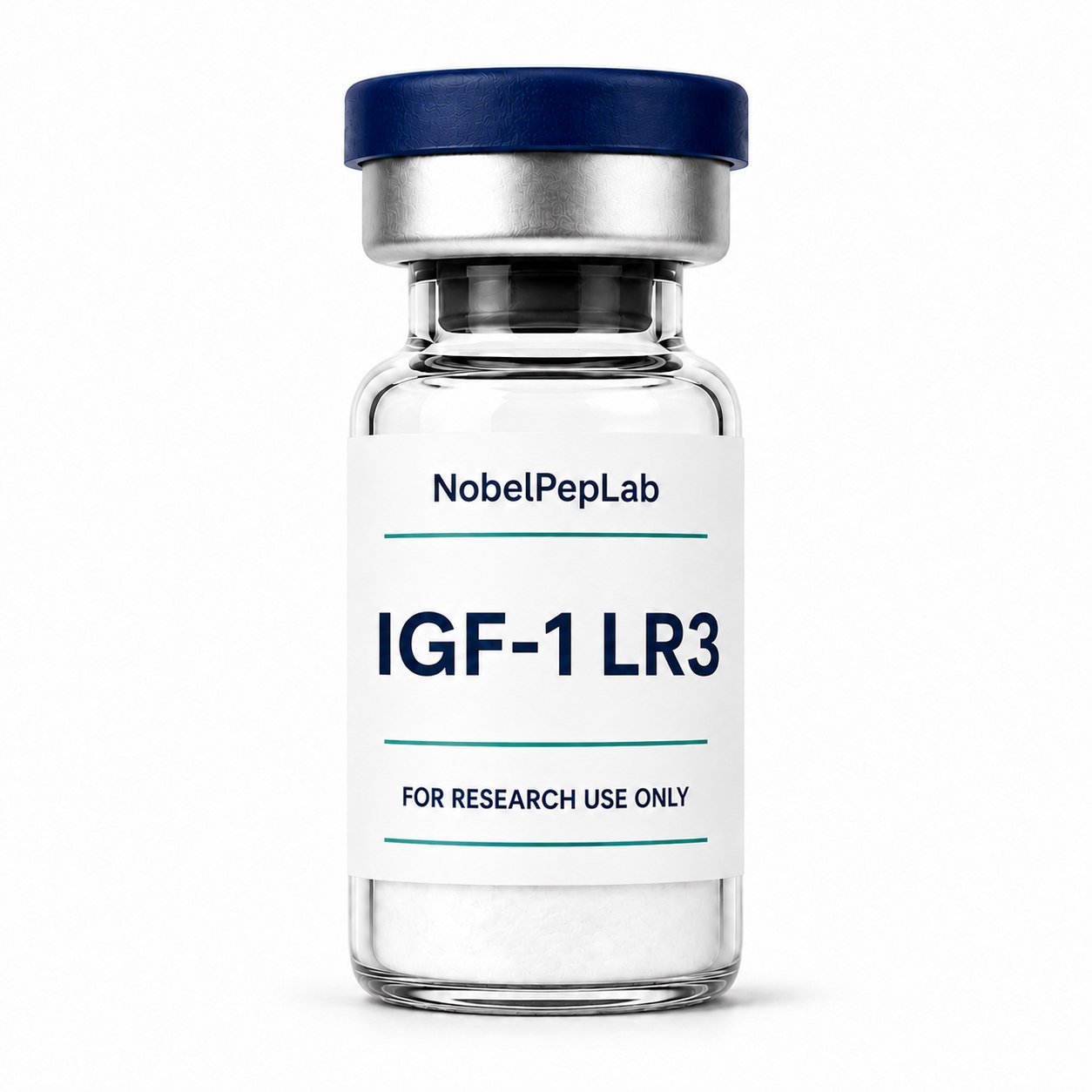
IGF-1 LR3 is a recombinant 83-residue analogue of insulin-like growth factor 1. It carries an arginine substitution at position 3 and a 13-residue N-terminal extension, both of which reduce binding to IGF-binding proteins. Unlike the rest of this catalog it is a recombinant protein rather than a synthesised peptide. It is supplied as a lyophilised powder in sealed vials, boxed in tens, for laboratory research use only.
$70.71 (£55.86) per box of 10 vials · 0.1 mg, 1 mg
Overview
What is IGF-1 LR3?
IGF-1 LR3 is a recombinant 83-residue analogue of insulin-like growth factor 1. It carries an arginine substitution at position 3 and a 13-residue N-terminal extension, both of which reduce binding to IGF-binding proteins. Unlike the rest of this catalog it is a recombinant protein rather than a synthesised peptide. It is supplied as a lyophilised powder in sealed vials, boxed in tens, for laboratory research use only.
IGF-1 LR3 at a glance
| Compound | IGF-1 LR3 |
|---|---|
| Also known as | Long R3 IGF-1, LR3 IGF-1, IGF-1 Long R3 |
| Classification | Recombinant 83-residue analogue of insulin-like growth factor 1 |
| CAS number | 946870-92-4 |
| Molecular weight | ~9111 g/mol |
| Sequence | 83 residues: Arg substituted at position 3, plus a 13-residue N-terminal extension |
| Purity | 99%+ by HPLC |
| Physical form | Lyophilised powder |
| Available strengths | 0.1 mg, 1 mg |
| Box quantity | 10 vials |
| Price from | $7.07 per vial ($70.71 per box) |
| Research status | Not a medicine. Supplied and used as a cell culture reagent. Prohibited in competitive sport under the WADA S2 category. |
| Documentation | Batch-specific COA (Janoshik or Freedom Diagnostic) |
Nominal specifications. The authoritative figures for any given box are those printed on its batch COA.
Pricing
How much does IGF-1 LR3 cost?
IGF-1 LR3 starts at $7.07 per vial (£5.59), sold in boxes of 10 at $70.71. One box is the smallest order and there is no trade account or minimum spend. Larger volumes are negotiable.
| Strength | Per vial | Box of 10 |
|---|---|---|
| 0.1 mg | $7.07 £5.59 | $70.71 £55.86 |
| 1 mg | $18.03 £14.24 | $180.28 £142.42 |
Handling
How should IGF-1 LR3 be stored and reconstituted?
Full explanation of why each of these matters: peptide handling and storage reference.
Research Context
What is IGF-1 LR3 researched for?
Below is a plain-English summary of what published research has investigated, and what it has found. These are descriptions of research activity and published results. They are not claims about what IGF-1 LR3 does, and nothing here is a statement that it is safe or effective for any purpose.
Cell culture supplementation
This is its principal legitimate use. IGF-1 LR3 supports growth and survival of cultured cells and, because it resists binding proteins, works at far lower concentrations than native IGF-1. Biotechnology manufacturers use it in production media for exactly that reason. 2
Escaping binding proteins
In serum, over 95 percent of native IGF-1 is bound to IGF-binding proteins and inactive. The Arg3 substitution and the 13-residue N-terminal extension sharply reduce that binding, so a known quantity stays available. That is the entire design rationale. 1
IGF-1 receptor signalling
Used to study the receptor pathway controlling cell growth, protein synthesis and survival, without the confounding variable of binding-protein sequestration.
References
- 1Short-term infusion of LongR(3) insulin-like growth factor (IGF)-I decreases hepatic IGF-I mRNA but not IGF binding protein-3 mRNA expression in pigs. Gen Comp Endocrinol (2002). PMID 12030778
- 2Insulin-like growth factor I (IGF-I) and long R(3)IGF-I differently affect development and messenger ribonucleic acid abundance for IGF-binding proteins and type I IGF receptors in in vitro produced bovine embryos. Endocrinology (2001). PMID 11181549
Links open the record on PubMed or PubMed Central. These are citations to published research, not claims about this product.
Applications
Where IGF-1 LR3 is used in the laboratory
- IGF-1 receptor binding and signalling studies
- Cell culture media supplementation research
- IGF-binding protein interaction studies
- Comparative work against native IGF-1
Verification
Does IGF-1 LR3 come with a COA?
Yes — every box. Each batch of IGF-1 LR3 is analysed by Janoshik Analytical or Freedom Diagnostic. The certificate confirms identity by mass spectrometry and purity by HPLC, and is tied to the batch number printed on the vial label. You can ask to see it before you order.

Example COA. You receive the certificate matching your own batch.
Questions
IGF-1 LR3 questions, answered
Why is IGF-1 LR3 used instead of native IGF-1 in cell culture?
Native IGF-1 is bound and sequestered by IGF-binding proteins present in serum and secreted by many cell lines, which makes the effective concentration hard to control. The Arg3 substitution and N-terminal extension in LR3 sharply reduce that binding, so a known quantity stays available in the medium.
How much does IGF-1 LR3 cost?
IGF-1 LR3 starts at $7.07 per vial, sold in boxes of 10 vials at $70.71 per box (about £55.86). 2 strengths available: 0.1 mg, 1 mg. There is no minimum order.
What purity is your IGF-1 LR3?
All batches test at 99%+ purity. Every box ships with a batch-specific Certificate of Analysis from Janoshik Analytical or Freedom Diagnostic, confirming identity by mass spectrometry and purity by HPLC.
Is there a minimum order for IGF-1 LR3?
No. You can order a single box of 10 vials. There is no trade account, bulk commitment or minimum spend.
How is IGF-1 LR3 shipped?
Tracked and in discreet, plain packaging, dispatched within 1–3 working days. Delivery estimates are UK 5–7 working days, EU 8–10, USA 5–8 and rest of world 10–12. Full detail is on the shipping page.
Catalog